“Erudite and original. Jason Jackson argues that economic policymaking in India is influenced by a moral economy favoring ‘modern’ capitalists—those seen as likely to grow industries and develop opportunities at home. This is a must-read for both students of Indian political economy and those interested in how ideas shape economic policymaking more broadly.”
—Atul Kohli (Princeton University)
“A masterful and absolutely unique analysis of how foreign investment policies in India have been powerfully shaped by economic ideas and moral beliefs. On one level, Jackson clearly traces how changing interpretations of ‘legitimate’ capitalist activity underwrote different policy paradigms. On another level, however, he uses the Indian case to develop new insights into classic developmental debates about how to morally evaluate economic behavior.”
—Patrick Heller (Brown University)
“This persuasively argued and conceptually innovative work will significantly reshape how scholars across disciplines understand the political economy of modern India. With theoretical sophistication and clarity, Jackson successfully explains the puzzle of the Indian state’s changing attitudes to both foreign and domestic capital in a way that is sure to have wide applicability.”
—Mircea Raianu (University of Maryland)
“A revelatory examination of investment policy in India, shedding new light on how beliefs about morality inform a range of financial behaviors and influence the flow of capital. Jason Jackson has produced a superb work of social science, weaving together finance, political economy, sociology, and history with contemporary reporting. A reminder of how meanings make our markets.”
—Frederick F. Wherry (Princeton University)
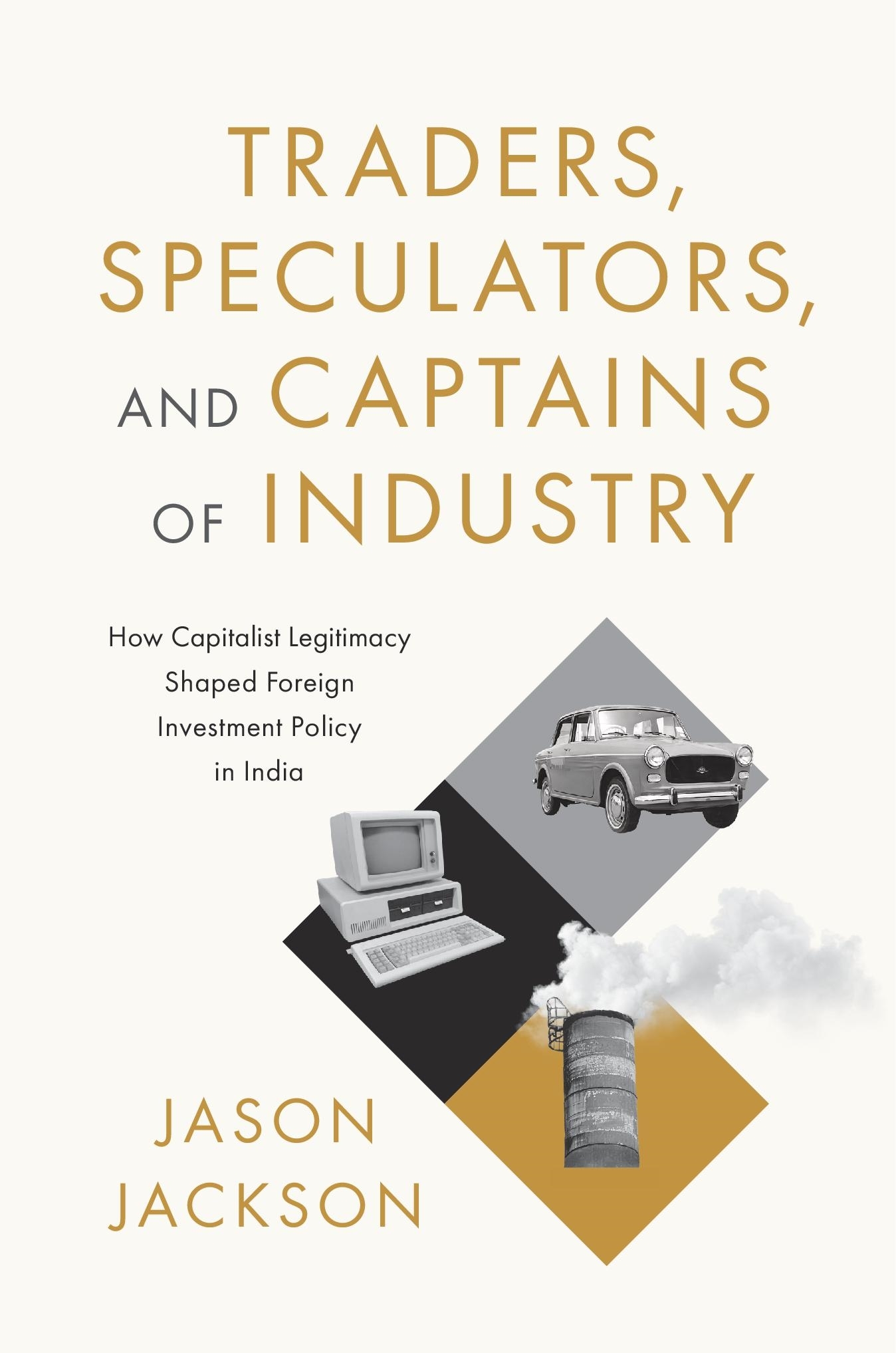
Traders, Speculators, and Captains of Industry: How Capitalist Legitimacy Shaped Foreign Investment Policy in India (Harvard University Press)
The dual rise of neoliberalism and economic nationalism is a defining feature of our time. Traders, Speculators, and Captains of Industry directly addresses this paradox through historical analysis of the capitalist transition in India. It presents economic nationalism not a simply as a preference for domestic business over foreign firms, but as a state-led project of moral ordering of capital that is a fundamental part of capitalism. In the last few decades, an important body of work has challenged the false dichotomy between state and market in fostering development, growth and progress. This work has shown how states in both developing and industrialized countries play a fundamental role in shaping markets. This book builds on this work by unpacking the moral dimensions of economic policymaking. It shows how states design market rules to support business actors who are deemed to contribute positively to desired societal change, whether foreign or domestic, while constraining those considered to be regressive market actors. This market architecture produces a hierarchical ordering of capital that is explicitly moral in character. While focusing on the Indian case, this book seeks to advance a broader argument about the moral ordering of capital in modern capitalism. It identifies the intellectual roots of this moral ordering in tenets of market governance established in classical political economy. The book then illustrates how moral orders evolve. It analyzes economic nationalism as a project of political governance and market-making through domestic and foreign capital in colonial and post-independence India. Finally, it draws out the implications for understanding the role of morality elsewhere in the contemporary global economy.
This book focuses on the role of economic ideas and moral beliefs in shaping market economies. It does so by providing a novel analysis of the politics of foreign investment in India. It argues that Indian state elites perceive the challenges of building a national economy through moral categories of capitalist legitimacy. These categories are predicated on competing economic ideas about the costs and benefits of foreign investment in promoting economic development. The manuscript argues that economic ideas are embedded in historically salient cultural representations of the ethical ‘orientations’ and business practices of foreign and domestic firms. They serve as interpretive frames through which policymakers distinguish between firms that may inhibit or advance nationalist goals of industrial development and societal progress. The analysis centers on three key periods by showing how categories of capitalist legitimacy emerged in the colonial era, became institutionalized in post-independence policymaking, and are now deployed in the contemporary period of economic liberalization. They do so by shaping perceptions of foreign and domestic business actors as ‘traditional’, ‘rapacious’ and ‘speculative’ ‘traders’ or ‘modern’, ‘ethical’ ‘Captains of industry’. These are explicitly moral categories that guide policy efforts to support ‘legitimate’ strategies and constrain ‘illegitimate’ practices of competing domestic and foreign firms. The analysis thus contributes to a vibrant literature in comparative political economy and economic sociology on the politics of economic ideas and on the moralization of markets.
 JASON JACKSON